
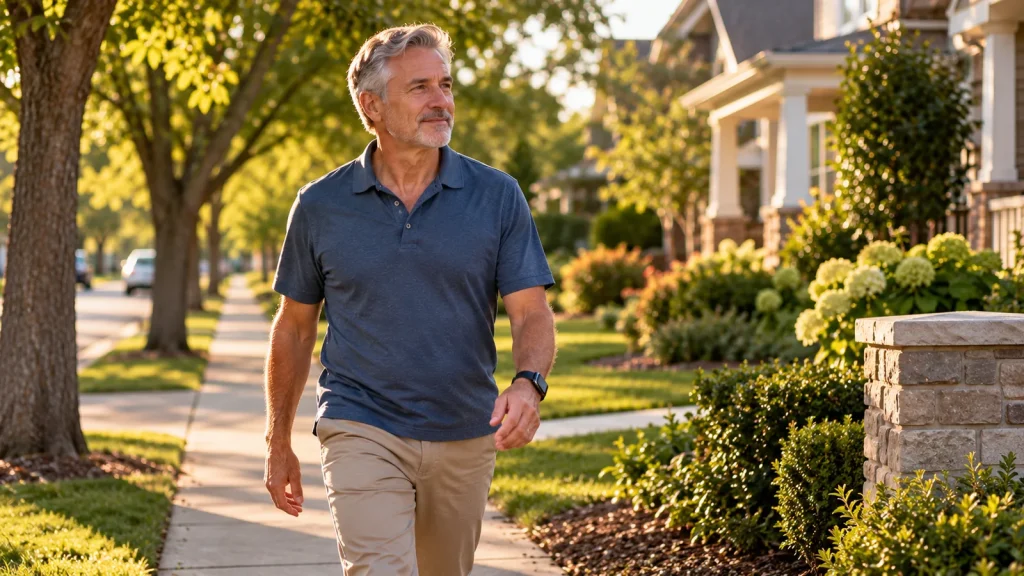
What if one of the simplest ways to support healthier blood sugar levels was to take a short walk after eating?
For men over 50, managing blood sugar can involve many decisions: what to eat, how much to exercise, and how to maintain healthy habits without turning every day into a complicated routine.
Walking after meals offers a practical option. Research suggests that even brief periods of movement after eating can help reduce the rise in blood glucose that follows a meal.
But how much walking is useful, when should you start, and does the approach work for people with type 2 diabetes?
Why Does Blood Sugar Rise After Eating?
When you eat carbohydrates, your digestive system breaks many of them down into glucose, which enters the bloodstream.
Insulin helps move glucose from the blood into cells, where it can be used for energy or stored for later.
In people with insulin resistance or type 2 diabetes, this process may be less efficient. As a result, blood glucose can rise higher or remain elevated longer after a meal.
This increase is called a postprandial glucose rise.
The size of the rise depends on several factors, including the amount and type of carbohydrates eaten, medications, physical activity, and individual metabolism.
How Walking After Meals Helps Blood Sugar Control
During walking, working muscles use glucose for energy. Muscle contractions also help glucose move into muscle cells through mechanisms that do not depend entirely on insulin.
That means light physical activity can help the body handle some of the glucose entering the bloodstream after eating.
Walking does not prevent digestion or eliminate carbohydrates from a meal. Instead, it may reduce how high blood glucose rises afterward.
For someone with insulin resistance, this can be particularly useful because muscle activity provides another pathway for glucose uptake.
Key point: A short walk after eating may help reduce a post-meal glucose rise, but the effect varies between individuals and does not replace diabetes medication, balanced nutrition, or regular exercise.
What Does the Research Say?
A 2023 systematic review and meta-analysis published in Sports Medicine compared exercise before and after meals.
The researchers found that exercise performed after eating generally reduced post-meal glucose elevations more than exercise performed before eating or remaining inactive.
However, the analysis included only eight small crossover trials, and the researchers identified a high risk of bias. The findings are promising, but they should not be treated as proof of an exact walking prescription for everyone.
A subsequent 2026 systematic review focused on adults with type 2 diabetes also found improvements in several continuous glucose monitoring measures following post-meal exercise.
Together, these studies support the practical value of moving after meals while leaving questions about ideal timing, duration, and long-term outcomes open.
How Long Should You Walk After a Meal?
You do not need to start with a long walk.
For many adults, five to ten minutes of comfortable walking after a meal is a reasonable starting point.
The Centers for Disease Control and Prevention specifically suggests a ten-minute walk after dinner as one way to begin becoming more active.
If walking feels comfortable, you may gradually extend the duration to 15 or 20 minutes.
There is no universal minimum that guarantees a specific reduction in blood glucose. Consistency, safety, and your current fitness level matter more than reaching an arbitrary number.
When Is the Best Time to Walk After Eating?
Research suggests that moving relatively soon after a meal may help limit the rise in blood glucose.
However, there is no scientifically established rule that everyone must begin walking exactly five, ten, or fifteen minutes after eating.
A practical approach is to start a comfortable walk shortly after finishing your meal, provided you feel well.
If you experience digestive discomfort, dizziness, or another symptom, adjust your timing and discuss persistent problems with a healthcare professional.
The best routine is one you can follow safely and consistently.
Is Walking After Dinner Better Than Walking After Breakfast?
Walking after breakfast, lunch, or dinner can be useful because each meal may produce a rise in blood glucose.
There is no need to assume that dinner is the only worthwhile time to walk.
For some men, a walk after breakfast fits naturally into the morning. Others find that a short walk after lunch helps interrupt long periods of sitting.
Walking after dinner may be particularly convenient because it can replace time normally spent sitting on the couch.
Choose the meal that fits your schedule. If you eventually add short walks after more than one meal, those minutes can contribute to your overall activity routine.
How Fast Should You Walk?
You do not have to power walk, jog, or push yourself to exhaustion.
A comfortable pace that allows you to speak normally is a sensible place to begin.
Some studies have used light walking, while others have examined more demanding exercise. The ideal intensity depends on your health and fitness.
If you have been inactive, beginning with gentle movement is generally more practical than immediately attempting a brisk pace.
Over time, you may increase your speed if it feels comfortable and your healthcare professional has not advised restrictions.
A Simple Post-Meal Walking Routine for Men Over 50
Rather than changing your entire schedule, begin with one meal.
- Choose a regular meal. Dinner or lunch may be easiest to start with.
- Finish eating and assess how you feel. Begin when you are comfortable and steady on your feet.
- Walk for five to ten minutes. Use a safe, level route at a comfortable pace.
- Build gradually. Add a few minutes as your stamina and confidence improve.
- Repeat consistently. Focus on developing a routine rather than chasing a perfect glucose reading.
Walking indoors, along a hallway, or around your home can be a useful alternative when weather or mobility makes outdoor walking difficult.
If walking is not suitable, ask your healthcare professional whether another form of gentle movement would be appropriate.
Can Walking After Meals Lower A1C?
A1C reflects average blood glucose over approximately two to three months.
Regular physical activity can contribute to improved long-term glucose management, including A1C, when performed consistently as part of an overall treatment plan.
However, research showing that a short walk reduces glucose immediately after a meal does not automatically prove that the same routine alone will produce a clinically meaningful A1C reduction.
Food choices, medication, sleep, overall activity, and other health conditions also influence long-term results.
Think of post-meal walking as one helpful component of diabetes management, not a stand-alone treatment.
Is Walking After Meals Safe for Everyone?
Walking is generally accessible, but certain medical conditions require additional precautions.
People taking insulin or sulfonylurea medications may experience low blood glucose during or after physical activity.
If your treatment can cause hypoglycemia, ask your diabetes care team when to check glucose, whether to carry fast-acting carbohydrates, and how to exercise safely.
Foot ulcers, severe neuropathy, balance difficulties, significant cardiovascular symptoms, or other exercise limitations may also require a modified plan.
Safety first: Stop exercising and seek medical evaluation if you develop chest pain, fainting, severe shortness of breath, or other concerning symptoms. If you suspect low blood glucose, follow your established hypoglycemia treatment plan rather than continuing to walk.
How to Know Whether Walking Is Helping
If you already monitor your blood glucose, you may notice differences in your readings after meals that include a walk.
Some people using continuous glucose monitors can observe how meals and activity affect their glucose patterns.
However, individual readings can vary because of meal composition, medications, stress, sleep, and other factors.
A single higher or lower reading does not prove that a particular walk succeeded or failed.
If you want to evaluate the effect, discuss appropriate glucose monitoring and interpretation with your diabetes care team.
Walking After Meals Versus Regular Exercise
Post-meal walks are helpful, but they should not replace a broader physical activity routine.
The American Diabetes Association recommends that most adults with diabetes work toward at least 150 minutes of moderate-to-vigorous aerobic activity each week, spread across several days.
Strength training and regular breaks from prolonged sitting also play important roles in metabolic health and physical function.
For men over 50, maintaining muscle, balance, and cardiovascular fitness is important for healthy aging.
Short walks after meals can complement these goals while making daily movement easier to maintain.
Final Thoughts: Small Walks Can Be Worthwhile
Walking after meals is a simple, low-cost habit that may help your body manage the rise in blood sugar that follows eating.
You do not need special equipment or an elaborate exercise plan to begin. A few comfortable minutes after one daily meal may be a practical first step.
For men over 50 with type 2 diabetes or prediabetes, the most important approach is to build a safe, sustainable routine that fits individual health needs.
Start small, stay consistent, and use post-meal walking as one part of a broader plan for blood sugar control and long-term health.
Medical Sources and Further Reading
- American Diabetes Association — Standards of Care in Diabetes 2026, Section 5
- Engeroff et al. — Exercise Before and After Meals: Systematic Review and Meta-analysis, 2023
- Systematic Review — Postprandial Exercise and Continuous Glucose Monitoring in Type 2 Diabetes, 2026
- CDC — Get Active
- Indian Health Service — Physical Activity and Diabetes