
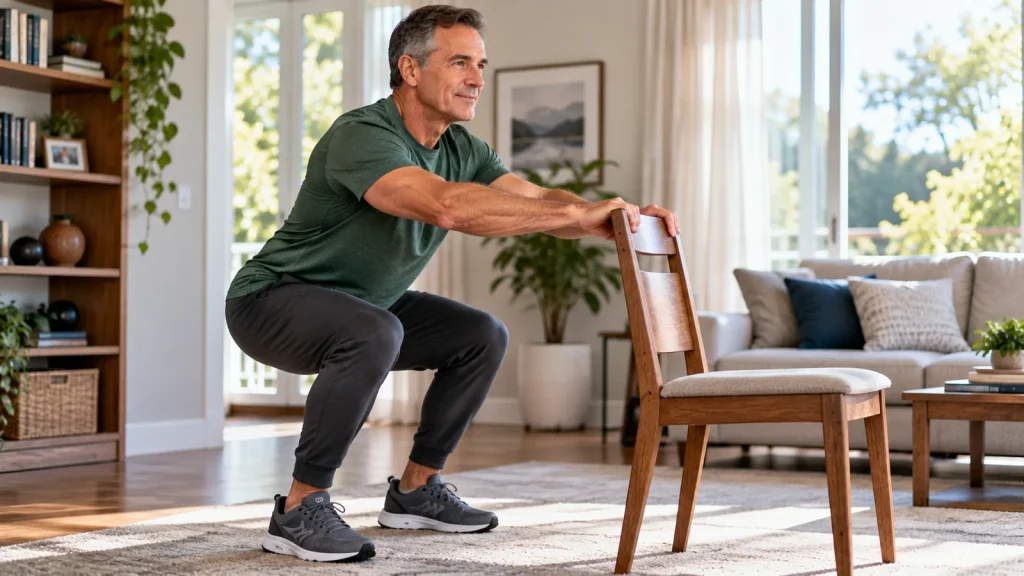
Getting stronger after 50 does not have to begin with a gym membership, heavy dumbbells, or complicated workout equipment. Some of the most accessible strength exercises use something you already have: your own body weight.
Bodyweight exercises can help men over 50 build strength, practice everyday movements, and improve physical function. They are especially useful for beginners who want to become more active at home.
The important part is choosing exercises that match your current abilities. A movement that feels easy for one person may be challenging for another, and starting safely matters more than performing advanced exercises.
What Are Bodyweight Exercises?
Bodyweight exercises use your body's weight as resistance instead of relying primarily on dumbbells, barbells, or exercise machines.
Examples include standing up from a chair, pushing against a wall, performing supported squats, and raising your heels while standing.
These movements can be adjusted by changing your body position, using a stable support, or limiting the range of motion.
According to the American College of Sports Medicine's 2026 resistance training guidance, bodyweight exercises and home-based routines can improve strength and physical function. Specialized gym equipment is not always necessary.
Why Bodyweight Training Matters After 50
Muscle strength supports many everyday activities, including climbing stairs, carrying groceries, standing from a seated position, and maintaining stability while moving.
As men age, physical inactivity and changes in muscle function can make these tasks more difficult. Regular strengthening activities help counter some of these changes.
Bodyweight training offers several practical advantages:
- Little or no equipment is required.
- Exercises can be performed at home.
- Many movements resemble everyday activities.
- Difficulty can be adjusted to individual abilities.
- Short workouts may be easier to maintain consistently.
Bodyweight exercises are not automatically safer than weight training. Proper technique, appropriate difficulty, and a suitable environment remain important.
Six Beginner-Friendly Bodyweight Exercises for Men Over 50
The following exercises are possible starting points for generally healthy adults. Begin with comfortable movements and use sturdy support whenever needed.
1. Sit-to-Stand From a Chair
This exercise strengthens the legs and hips while practicing a movement used repeatedly throughout the day.
- Choose a sturdy chair that will not slide or tip.
- Sit upright with your feet flat on the floor.
- Lean slightly forward and stand using your legs.
- Slowly lower yourself back into the chair.
Starting point: Try 5–8 controlled repetitions. Use your hands for assistance if necessary.
Make it easier: Use a higher, stable seat or assist yourself with your hands.
2. Wall Push-Ups
Wall push-ups work the chest, shoulders, and arms without requiring you to lower yourself to the floor.
- Stand facing a sturdy wall.
- Place your palms against the wall at approximately shoulder height.
- Step back slightly and bend your elbows.
- Bring your chest toward the wall, then push away.
Starting point: Try 6–10 slow repetitions.
Make it easier: Move your feet closer to the wall.
Avoid forcing the movement if you experience shoulder, wrist, or elbow pain.
3. Supported Mini Squats
Mini squats strengthen the thighs and hips while allowing a smaller range of motion than a deep squat.
- Stand near a stable countertop or railing.
- Place your feet approximately hip-width apart.
- Bend your hips and knees slightly, keeping your movement controlled.
- Return to standing without locking your knees forcefully.
Starting point: Try 5–8 repetitions.
Make it easier: Reduce the depth of the squat and use the support for balance.
4. Standing Calf Raises
Calf raises strengthen the muscles in the lower legs that contribute to walking and stair climbing.
- Stand upright while holding a stable countertop.
- Slowly lift your heels from the floor.
- Pause briefly at the top.
- Lower your heels with control.
Starting point: Try 8–12 repetitions.
Make it easier: Use both hands for support and lift your heels only as high as comfortable.
5. Standing Hip Extensions
This exercise activates the muscles around the hips and buttocks, which contribute to standing, walking, and lower-body stability.
- Stand behind a sturdy chair or at a countertop.
- Hold the support and keep your torso upright.
- Move one leg gently backward without arching your lower back.
- Return slowly and repeat with the other leg.
Starting point: Try 6–10 repetitions per leg.
Make it easier: Use a smaller movement and maintain firm hand support.
6. Standing Marches With Support
Supported marching challenges hip movement and weight shifting while offering an opportunity to practice balance.
- Stand beside a stable countertop or railing.
- Hold the support as needed.
- Slowly raise one knee to a comfortable height.
- Lower the foot and repeat with the opposite leg.
Starting point: Try 6–10 marches per leg.
Make it easier: Lift each foot only slightly and maintain both hands on a secure support.
This is primarily a gentle functional and balance exercise, not a complete substitute for progressive lower-body strength training.
How to Start a Bodyweight Workout Safely
Before beginning, choose a clear exercise area with a nonslip floor and stable furniture. Wear supportive footwear if appropriate for your balance and comfort.
Warm up with several minutes of comfortable walking or gentle movement. Then select three or four exercises rather than trying to complete everything immediately.
Start with one manageable set of each exercise. Rest as needed, breathe normally, and avoid rushing through repetitions.
Remember: The suggested repetitions are examples, not mandatory targets. Stop a set when you cannot maintain control or comfortable technique. If you have significant mobility limitations or a history of falls, professional supervision may be appropriate.
A Simple Beginner Bodyweight Routine
For someone starting from a low activity level, the following short routine may provide a manageable introduction:
- Sit-to-stand: 5–8 repetitions.
- Wall push-ups: 6–10 repetitions.
- Supported calf raises: 8–12 repetitions.
- Standing hip extensions: 6–10 per leg.
Begin with one set of each movement. If necessary, divide the routine into shorter sessions.
As you become more comfortable, gradually add supported mini squats or marching exercises. Rest between movements as needed.
This introductory routine does not fully train every major muscle group, particularly the upper-back pulling muscles. As your confidence grows, consider adding an appropriate resistance-band row or another pulling exercise to develop a more balanced program.
How Often Should Men Over 50 Do Bodyweight Exercises?
U.S. physical activity guidelines recommend muscle-strengthening activities involving all major muscle groups on at least two days each week.
For beginners, two nonconsecutive strength sessions can be a practical goal. Allow time to recover between challenging workouts, especially when your muscles are not accustomed to exercise.
Men who have been inactive may begin with shorter, less demanding sessions and gradually work toward the recommended frequency.
Walking and other comfortable aerobic activities can complement strength training on other days. Adults 65 and older should also include activities that support balance.
How Do You Make Bodyweight Exercises More Challenging?
Once an exercise becomes comfortable, you can gradually increase the challenge.
Possible adjustments include adding a few repetitions, performing an additional set, moving more slowly, or using a slightly more demanding variation.
For example, a wall push-up may eventually progress to a push-up against a sturdy, appropriately secured countertop. A supported chair stand may become easier to perform with less assistance.
Progress should be gradual. Avoid changing several aspects of your routine at once, and do not sacrifice technique simply to complete more repetitions.
Bodyweight training has limitations. Some muscle groups, particularly the back, can be difficult to challenge adequately without equipment. Resistance bands or weights may eventually provide useful additional options.
Common Mistakes to Avoid
Starting With Advanced Exercises
Floor push-ups, deep lunges, and unsupported single-leg exercises may be too demanding for some beginners. Easier variations can provide a more appropriate starting point.
Using Unstable Furniture
Lightweight chairs, rolling office chairs, and unsecured tables can shift unexpectedly. Use stable, nonslip supports designed or suitable for the task.
Holding Your Breath
Try to breathe naturally during each repetition. Avoid prolonged breath-holding and excessive straining, especially if you have blood pressure or cardiovascular concerns.
Ignoring Pain or Dizziness
Normal muscular effort is different from sharp pain, unusual breathlessness, or dizziness. Stop the activity if concerning symptoms occur.
Expecting Immediate Results
Improvement takes repeated practice. Early progress may appear as easier movements, greater confidence, or better control before noticeable changes in muscle size.
When Should You Speak With a Healthcare Professional?
Men with unstable cardiovascular conditions, recent surgery, significant joint problems, recurrent falls, or unexplained weakness should discuss appropriate exercise options with a qualified healthcare professional.
Physical therapists can help adapt movements for people with pain, balance difficulties, or reduced mobility.
Stop exercising and seek urgent medical attention for chest pain, fainting, sudden severe shortness of breath, or sudden neurological symptoms.
The Bottom Line: Start With What You Can Do
Bodyweight exercises offer a practical way for men over 50 to begin building strength without complicated equipment.
Chair stands, wall push-ups, supported squats, and other simple movements can help develop confidence and improve everyday physical function.
There is no need to master advanced exercises or complete long workouts immediately. Choose manageable movements, prioritize good technique, and increase the challenge gradually.
The goal is not to perform the hardest workout possible. It is to establish a safe, sustainable habit that supports strength and mobility over time.
Scientific References
- Currier BS, et al. Resistance Training Prescription for Muscle Function, Hypertrophy, and Physical Performance in Healthy Adults. Medicine & Science in Sports & Exercise. 2026. Read study.
- American College of Sports Medicine. ACSM Publishes Updated Resistance Training Guidelines. 2026. Read guidance.
- Centers for Disease Control and Prevention. Older Adult Activity: An Overview. 2025. Read recommendations.
- U.S. Department of Health and Human Services. Physical Activity Guidelines for Americans. 2nd edition. 2018. Read guidelines.